Guide · Engineering plastics
Acetal vs Nylon Bushings: Which Material Fits Your Application?
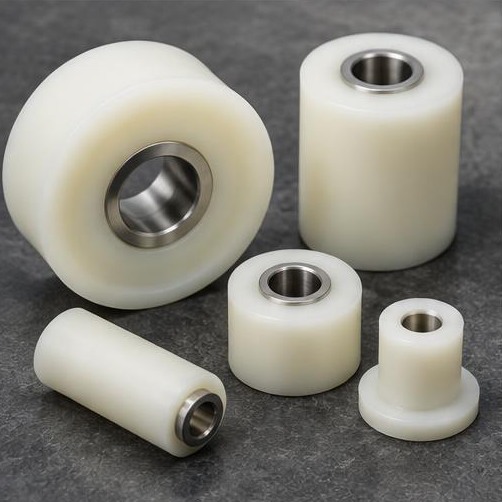
Acetal is generally less moisture-sensitive than nylon, while nylon's moisture conditioning can change both dimensions and mechanical behaviour. Choose a specific grade using the load, movement, lubrication, temperature and inspection condition of the actual bushing. Neither family is automatically the right bearing material for every application.
ISO 9001:2015 Certified
Documented quality management system
Mitutoyo Quality Inspection
Calipers, micrometers, height gauge, DTIs
Export-Ready Packaging
VCI film, ISPM-15 wooden crates
RFQ Response in 24 Hours
Quote within one working day
NDA Available
Your drawings stay confidential
On this page9 sections
Start here
Specify the polymer grade first
Acetal is a POM material family; Delrin is a brand associated with acetal homopolymer, not a name for every POM grade. Acetal copolymer and homopolymer must not be substituted without engineering approval. Nylon is also a family that includes different formulations and production routes. A drawing that says only plastic or nylon leaves important decisions unresolved.
Give the approved grade, filler, colour restrictions and stock form where they matter. Request the relevant manufacturer's datasheet and material identification for the supplied stock. Typical datasheet properties are comparison information, not guaranteed properties of the finished assembly. Confirm whether listed results describe unfilled, reinforced, dry or conditioned material.
- 01 / 06
Moisture changes the comparison
Nylon absorbs moisture, and its dimensions and mechanical response can change with conditioning. Acetal is generally less moisture-sensitive, which can be helpful when dimensional stability is a major purchasing requirement. The engineering decision still needs the actual grade, expected humidity, liquid exposure and permitted clearance change.
For a nylon bushing, define the condition at machining, inspection and service. A dry inspection result may not predict the installed clearance after moisture exposure. Agree whether conditioning or storage controls are needed and who is responsible for them. Do not create a compensating machining allowance without an approved dimensional model and acceptance limits.
- 02 / 06
Evaluate the whole bearing interface
A bushing's wear behaviour depends on more than polymer selection. Shaft finish, alignment, debris, lubricant, speed and load affect the interface. Compare grade-specific guidance under conditions close to the application rather than using a single friction figure from unrelated tests. A material advertised as self-lubricating still needs application validation.
State whether movement is continuous rotation, oscillation or occasional sliding. Identify any edge loading and misalignment, because local contact can differ from the assumed average load. Ask the design engineer to review the mating shaft surface and the intended lubrication strategy together with the polymer. Machining accuracy cannot correct an unsuitable bearing design.
Illustrative machining and inspection imagery. - 03 / 06
Temperature and chemicals need separate checks
An acceptable room-temperature fit can change during operation as the polymer and mating metal respond differently to temperature. Review expansion, stiffness and sustained loading for the selected grade. A published maximum temperature is not a blanket permission to use a highly loaded precision bushing continuously at that limit.
List cleaning agents, oils, coolants and process chemicals with their concentrations and exposure temperatures. Use the material manufacturer's compatibility information and an application test where necessary. Do not infer resistance from a general statement that nylon is tough or acetal is stable. Colour, fillers and grade modifications can also change the relevant properties.
- 04 / 06
Turn material choice into an inspection plan
Specify outside diameter, installed bore requirement, length, flange dimensions and datum relationships. Identify which values apply to the uninstalled part and which require verification after assembly. Thin plastic walls can respond to clamping and measurement force, so the supplier should confirm a suitable measuring method before committing to critical limits.
For a new bushing, retain first-article dimensions alongside the assembly test record and material batch identification. Repeat orders should preserve the accepted grade and drawing revision. If stock availability prompts a proposed substitute, review it as an engineering change rather than approving it solely because its family name sounds similar.
- 05 / 06
Compare material options on one acceptance record
When testing two approved grades, keep the geometry and test conditions controlled so the results can be attributed to the material decision. Record the supplied grade, conditioning, mating shaft condition and assembly method for each sample. Inspect before and after the agreed exposure or operation, using the same measurement procedure where practical. Have the engineer define pass criteria before looking at the results. If a dimensional change is observed, distinguish moisture, temperature, loading and measurement effects rather than attributing everything to wear. Retain the accepted sample and report as a repeat-order reference.
Illustrative machining and inspection imagery. - 06 / 06
RFQ details that make the decision actionable
Send the drawing, approved grade or permitted alternatives, shaft and housing dimensions, operating environment, required quantity and inspection condition. Explain the current failure if you are replacing an existing component: binding, wear, noise and dimensional drift are different symptoms. A photograph or worn sample can support investigation but does not define the original design intent.
Precision Machining India reviews Nylon and Delrin machining requirements from Pune. Request separate quotations for engineer-approved material options with the same geometry and inspection scope. Final material approval remains an application-specific engineering decision; a lower stock price alone is not a reason to accept a substitution.
Frequently asked questions
Get a quote in 24hIs Delrin the same as all acetal?
No. Delrin homopolymer and acetal copolymer are distinct material choices; specify the approved grade.
Should nylon bushings be measured dry?
The drawing and inspection plan should define the required moisture condition for the application.
Technical references
Keep exploring
Related capabilities, materials and markets
Everything below is machined in the same Pune plant to the same ISO 9001:2015 system. Follow whichever is closest to the part you are sourcing.
Related resources
6- PEEK vs PTFE: Choosing Material for Machined Components
- Machined Plastic Insulators: RFQ Checklist for OEM Buyers
- Machined Plastic Insulators Cost: What Changes a Supplier Quote?
- Machined Plastic Insulators: Design-for-Manufacture Review
- Machined Plastic Insulators: Material Selection Before Ordering
- Machined Plastic Insulators: Tolerances, Fits and Datum Decisions
Machining capabilities
1Request for quotation
Send your drawing. Get a quote in 24 hours.
Upload STEP, IGES or PDF files. NDA available on request. Quoting: Acetal vs Nylon Bushings: Which Material Fits Your Application?.