Guide · Engineering plastics
PEEK vs PTFE: Choosing Material for Machined Components
PTFE is known for low friction and broad chemical resistance, but deformation under sustained load needs attention. PEEK offers a different mechanical and thermal profile. Select the exact grade for the part's load, temperature, chemicals and dimensional requirements rather than treating either material as universally better.
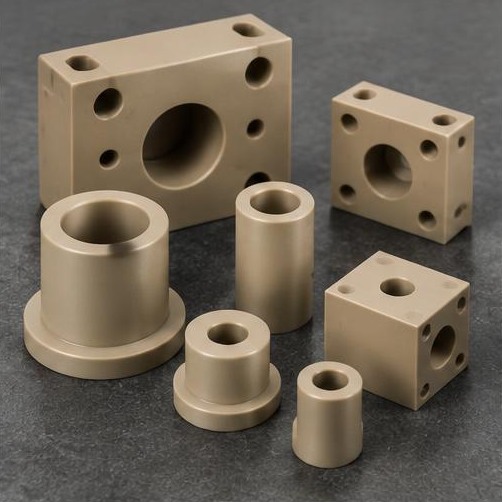
ISO 9001:2015 Certified
Documented quality management system
Mitutoyo Quality Inspection
Calipers, micrometers, height gauge, DTIs
Export-Ready Packaging
VCI film, ISPM-15 wooden crates
RFQ Response in 24 Hours
Quote within one working day
NDA Available
Your drawings stay confidential
On this page9 sections
Start here
Start with the failure you must prevent
A valve seat, insulating spacer and pump wear component do not have the same material-selection problem. Identify whether the critical issue is leakage, deflection, electrical behaviour, wear or dimensional movement. Describe the mating surfaces and how the part is loaded. This prevents a premium material name from substituting for a functional specification.
List the required properties and separate mandatory limits from preferences. A part may need chemical compatibility but only modest structural stiffness; another may need shape retention under load as well as compatibility. Compare approved grades using these requirements before comparing stock prices. The design engineer should own the final application decision.
- 01 / 06
Review sustained loading and deformation
PTFE's low friction can be useful at a sliding or sealing interface, but sustained loading can lead to deformation. Grade and fillers affect behaviour, so an unfilled PTFE result cannot represent every filled formulation. The amount of permitted movement must be related to sealing, clearance or alignment in the actual assembly.
PEEK may be considered where the design needs a different combination of stiffness and thermal performance. Do not compare headline strength values without checking the test method, material condition and temperature. Neither a resin datasheet nor a machining inspection report establishes the long-term performance of an unsupported wall or heavily loaded contact.
- 02 / 06
Check chemical exposure precisely
Broad chemical resistance is not a universal compatibility guarantee. Name each process fluid, cleaner and lubricant, including concentration, temperature and exposure duration. Review the specific grade's manufacturer information. A component that survives intermittent cleaning may behave differently during continuous immersion or when chemicals and mechanical stress act together.
Filled grades need their own review because the filler can alter both performance and compatibility. Do not approve a substitution based only on the polymer family. When published information does not match the operating conditions, plan an application test and retain its results. State any contamination, cleanliness or material-identification requirements in the RFQ.
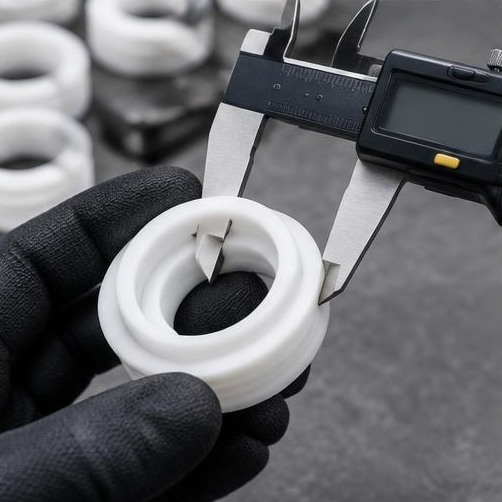
Illustrative machining and inspection imagery. - 03 / 06
Do not use temperature ratings in isolation
Temperature affects dimensions and mechanical behaviour as well as survival of the material. Review normal operation, start-up conditions and short excursions separately. A continuous-use rating from a datasheet is not a precision-fit guarantee at that temperature. Mating metal and polymer parts may expand differently, changing the clearance or contact pressure.
For steam, hot water or thermal cycling, seek grade-specific guidance and consider the complete assembly. Record the acceptable dimensional change and inspection temperature. Do not advertise a single universal PEEK or PTFE service limit for every machined component, particularly where sustained load, repeated cycling or tight mating fits are involved.
- 04 / 06
Define the machined-part acceptance criteria
Specify the exact stock grade, drawing revision, critical geometry and required surface condition. Plastic components can respond to workholding and inspection force, so agree how delicate walls and bores will be measured. Separate size, flatness and alignment requirements instead of relying on one general tolerance for a sealing face or precision locator.
For an initial order, compare the dimensional report with functional testing. A conforming part can still fail if the selected material does not suit its duty. Retain the batch identity, assembly conditions and test results before approving repeat supply. Any later change in grade, filler or stock source should be reviewed against the original acceptance criteria.
- 05 / 06
Record the basis of a material approval
Keep the selected grade and its dated datasheet with the application review. Identify the load, chemicals and operating temperatures used in the decision, plus any test results and unresolved limitations. If a later process change introduces a different cleaner or higher temperature, revisit the material approval instead of relying on the original part number. For filled grades, keep the filler description in the specification. A replacement stock source should be checked against the approved grade and documentation. This record helps separate a manufacturing nonconformance from a material-selection issue when a component behaves unexpectedly in service.
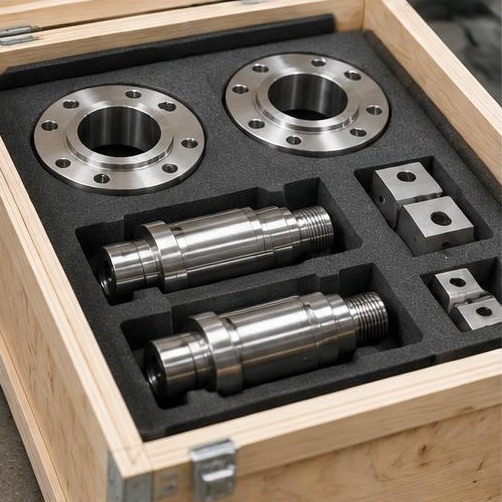
Illustrative machining and inspection imagery. - 06 / 06
Compare options without inventing savings
Ask for quotations for each engineer-approved option using the same drawing, quantity, inspection and packing requirements. Material cost, stock availability and machining requirements can differ, but no universal price multiple should be assumed. If changing material also requires changing wall thickness or clearances, quote the revised design as a separate option.
Precision Machining India reviews PTFE and PEEK components machined to drawing at its Pune plant. Send the operating environment and required documentation with the model. Ask for clarification of grade availability and machining feasibility before ordering. The quotation should describe the supplied part; it should not imply an unverified medical, aerospace or electrical certification.
Frequently asked questions
Get a quote in 24hIs PEEK always better than PTFE?
No. Select the specific grade for the load, sliding or sealing function, chemicals, temperature and dimensional limits.
Can filled PTFE replace unfilled PTFE without approval?
No. Fillers can change properties and compatibility; substitutions need application-specific engineering approval.
Keep exploring
Related capabilities, materials and markets
Everything below is machined in the same Pune plant to the same ISO 9001:2015 system. Follow whichever is closest to the part you are sourcing.
Related resources
6- Acetal vs Nylon Bushings: Which Material Fits Your Application?
- Machined Plastic Insulators: RFQ Checklist for OEM Buyers
- Machined Plastic Insulators Cost: What Changes a Supplier Quote?
- Machined Plastic Insulators: Design-for-Manufacture Review
- Machined Plastic Insulators: Material Selection Before Ordering
- Machined Plastic Insulators: Tolerances, Fits and Datum Decisions
Machining capabilities
1Request for quotation
Send your drawing. Get a quote in 24 hours.
Upload STEP, IGES or PDF files. NDA available on request. Quoting: PEEK vs PTFE: Choosing Material for Machined Components.