Material
PTFE (Teflon) Machining & Custom Parts
Looking for a reliable source of PTFE (Teflon) Machined Parts? Precision Machining India manufactures to your drawing at our ISO 9001:2015 certified plant in Pune, India, and supplies OEMs and procurement teams worldwide.
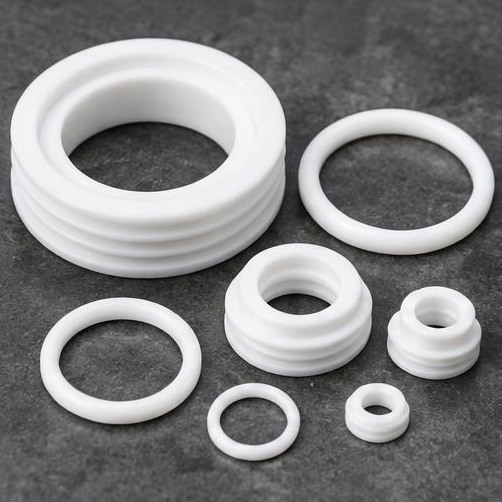
ISO 9001:2015 Certified
Documented quality management system
Mitutoyo Quality Inspection
Calipers, micrometers, height gauge, DTIs
Export-Ready Packaging
VCI film, ISPM-15 wooden crates
RFQ Response in 24 Hours
Quote within one working day
NDA Available
Your drawings stay confidential
On this page15 sections
Direct answer
Which PTFE grades do you machine?
Yes. Precision Machining India machines PTFE parts to customer drawings at its ISO 9001:2015 certified plant in Pune, India, in Virgin PTFE, glass-filled, carbon-filled, bronze-filled. Work is turned on CNC turning centres and milled on a 3-axis VMC with a 800 × 500 × 400 mm bed, holding ±0.05 mm typical, ±0.025 mm on selected diameters. Grades are stocked or sourced against your specification, and EN 10204 3.1 mill certificates are supplied on request. Quantities run from a single prototype to 10,000+ pieces with no fixed minimum, and RFQs are answered within 24 hours.
- Grades: Virgin PTFE, glass-filled, carbon-filled, bronze-filled
- Tolerance: ±0.05 mm typical, ±0.025 mm on selected diameters
- Finishes: As-machined, fine turned for sealing faces
- Typical parts: valve seats, seals and rings, chemical liners and bearing pads
- Quantities: single prototype to 10,000+ pieces, no fixed minimum order
- Documents: dimensional inspection report with the shipment, EN 10204 3.1 mill certificate on request
At a glance
Materials & technical specifications
PTFE (Teflon) machining notes: Soft and creeps under load; we use sharp high-rake tools, light clamping and measure at controlled temperature.
- Process
- PTFE Machining
- Materials
- PTFE (Teflon)
- Grades
- Virgin PTFE, glass-filled, carbon-filled, bronze-filled
- Key properties
- Chemically inert, lowest friction of any solid, service from −200 °C to +260 °C, excellent electrical insulator.
- Standard tolerance
- ±0.05 mm typical, ±0.025 mm on selected diameters
- Surface finish
- As-machined, fine turned for sealing faces
- Max turning size
- Ø400 × 1200 mm (conventional), bar work on CNC lathes
- Max milling envelope
- 800 × 500 × 400 mm (VMC)
- Threading
- M3–M32 auto tapping; metric, BSP, NPT, UNC/UNF
- Batch size
- 1 prototype to 10,000+ pieces
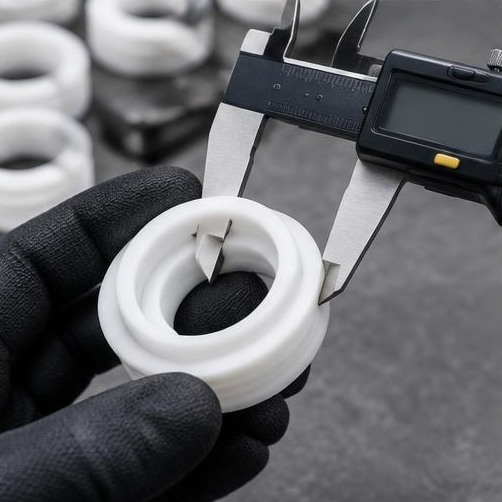
PTFE (Teflon) Machined Parts: overview
Seals, seats, rings and liners in virgin and filled PTFE. PTFE is turned and milled with sharp, high-rake tools at controlled speeds. Parts are stress-relieved where needed and measured after temperature stabilisation because PTFE expands with heat.
Every order is programmed in VISI or Delcam CAM, machined on CNC turning centres and VMC, and inspected in our Mitutoyo quality lab before it is packed and shipped.
PTFE Machining capability
Our ptfe machining cell handles single prototypes through repeat batches of tens of thousands. Typical work includes flanges, bushings, valve components, insulators and seals & rings.
Before quoting, our engineers review your STEP, IGES or PDF drawing for machinability and suggest changes that reduce cost without affecting function.
- CNC turning centres (LMW, Jyoti, Ace Micromatics): Shafts, bushings, fittings, turned plastic parts
- Vertical machining centre (VMC) (Ace Micromatics, FANUC control): 3-axis milling, bed 800 × 500 × 400 mm
- Auto tapping machines (M3 to M32 capacity): High-volume internal threading
- Conventional lathe (Uma Enterprises): Turning up to Ø400 × 1200 mm
- Band saw (Rajlaxmi): Bar stock cutting and blank preparation
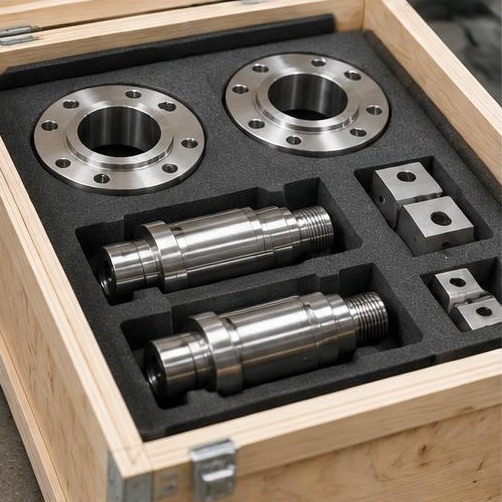
Tolerances & surface finish
Standard capability for this work is ±0.05 mm typical, ±0.025 mm on selected diameters. Bores can be held to H7 and bearing seats to h6/g6 fits. Where your drawing calls for tighter limits, we agree the critical characteristics up front and record them on the inspection report.
As-machined finishes of Ra 1.6–3.2 µm suit most functional surfaces. For seals, bearing journals and sliding fits we run a fine finishing pass to reach Ra 0.8 µm.
Plating, anodising, passivation and heat treatment are arranged through qualified partners and re-inspected in-house before packing.
Quality inspection process
Our ISO 9001:2015 system covers incoming material, first-article inspection, in-process checks and final inspection. Records are kept for every batch so any part can be traced back to its material heat.
Every shipment includes a dimensional inspection report, with material test certificates (EN 10204 3.1) on request.
- Mitutoyo digital vernier calipers
- Mitutoyo height gauge
- Granite surface plate
- Mitutoyo outside micrometers
- Inside calipers and bore gauges
- Dial test indicators
PTFE grades we machine
The grade decides cost, cycle time and how the part performs. Use these notes to confirm the designation before you release the drawing.
Virgin PTFE
Unfilled
- Condition
- Moulded billet, sintered and stress-relieved
- Key property
- Chemically inert, the lowest friction of any solid, and an excellent insulator
- Typical use
- Valve seats, static seals, chemical liners, insulating washers
Glass-filled PTFE
Typically 15–25% glass fibre
- Condition
- Moulded and sintered billet
- Key property
- Creeps far less under load and wears better; friction rises slightly
- Typical use
- Dynamic seals, wear rings and bearing pads carrying load
Carbon-filled PTFE
Carbon, often with graphite
- Condition
- Moulded and sintered billet
- Key property
- Higher compressive strength and heat transfer, but electrically conductive — not an insulator
- Typical use
- Piston rings, rotary seals, parts running in water or steam
Bronze-filled PTFE
High bronze loading
- Condition
- Moulded and sintered billet
- Key property
- The best wear resistance and dimensional stability of the filled grades; unsuitable for acid service
- Typical use
- Heavily loaded bearing pads, wear strips, hydraulic guide rings
Choosing between PEEK and PTFE
Buyers usually weigh PTFE against PEEK. Here is how the two compare on the points that decide the order.
| Criterion | PEEK The metal-replacement polymer for heat and load | PTFE (Teflon) Inert and low friction, but soft and prone to creep |
|---|---|---|
| Machinability and cycle time | Predictable with carbide tooling and light finishing passes. Filled grades are abrasive to tools, and stock is stress-relieved between passes where the tolerance is tight. | Cuts easily with sharp high-rake tools, but it is soft and creeps: light clamping, supported set-ups and measurement only after the part has stabilised in temperature. |
| Tolerance we hold | ±0.02 mm typical | ±0.05 mm typical, ±0.025 mm on selected diameters |
| Service temperature | About 250 °C continuous service, with a glass transition near 143 °C — the highest of the plastics we machine. | Continuous service from −200 °C to +260 °C — the widest range of the plastics we machine. |
| Corrosion and chemical resistance | Resistant to most chemicals and to hydrolysis in hot water and steam. Concentrated sulphuric acid attacks it. | Virtually inert to acids, alkalis and solvents. Fillers trade some of that away: glass fill is attacked by hydrofluoric acid and strong caustics, bronze fill by acids. |
| Relative cost | The highest material cost of the machinable plastics, several times acetal, so section size and stock allowance matter to the price. | Dearer than acetal and nylon, far below PEEK. Low stiffness means thicker sections and more stock removal. |
Values are indicative figures from published grade data, given to guide specification rather than to qualify a design; confirm them against the mill or polymer data sheet for your service conditions. Material selection remains your design responsibility. Grades are stocked or sourced per order, with EN 10204 3.1 certificates on request.
Industries we serve
This work is used across electronics & electrical, general engineering, aerospace and medical devices. Electronics & Electrical customers, for example, need insulating, dimensionally stable plastic parts free from contamination.
Our core customers are corporate OEMs in automotive, hydraulics, pumps & valves and general engineering, plus multinational companies that need PTFE, Nylon, Delrin and PEEK parts machined to drawing.
Export packaging & logistics
We export to 45+ countries from Nhava Sheva (JNPT), with sea transit of about 4–7 days to the Gulf, 18–28 days to Europe and the UK, and 25–35 days to North America. Air freight is available for urgent orders.
All parts are protected with VCI film and packed in ISPM-15 crates. We quote EXW, FOB or CIF to suit your logistics.
Why source from India with us
India has become a leading China+1 destination for precision machined components. For international buyers, we combine competitive piece prices with an ISO 9001:2015 quality system, English-speaking engineers and drawings worked to ISO, DIN and ASME standards.
We reply to RFQs within 24 hours, sign NDAs before receiving drawings, and give you one point of contact from quote to delivery.
- ISO 9001:2015 certified
- Mitutoyo quality inspection
- Export-ready packaging
- RFQ response in 24 hours
- NDA available
Specifying PTFE on your drawing
Most re-quotes on PTFE parts come from a missing grade, condition or datum rather than from the geometry.
Put this on the drawing
- Name the polymer and the filler — Virgin PTFE, for example — because filled and unfilled grades cut and move differently.
- Give the service temperature, the chemicals in contact and the mating material, so the grade can be confirmed against the maker's data sheet.
- Ask for the tolerance you actually need: ±0.05 mm typical, ±0.025 mm on selected diameters is standard, and tighter limits mean extra passes and stress relieving.
- State whether dimensions apply as machined or after conditioning at a stated temperature and humidity.
- Keep wall thicknesses sensible and corners radiused so parts do not deflect under clamping.
- Ask for individual bagging; machined plastics scratch and pick up contamination in bulk packing.
What causes scrap, delay or extra cost
- Metal tolerances on a polymer: a few degrees of temperature change moves a 100 mm plastic part more than ±0.01 mm.
- Thin unsupported walls and deep narrow slots, which deflect away from the tool and spring back after the cut.
- Press fits into metal with no allowance for the difference in thermal expansion across the working temperature range.
- Acceptance measured straight off the machine; parts must stabilise at a known temperature first.
- Biocompatibility or implant approval. The certification held is ISO 9001:2015, not ISO 13485; what is supplied is the material maker's data sheet and batch documentation.
- Reports from a CMM or in-house material testing — neither exists here; dimensional checks are made with Mitutoyo hand instruments on a granite surface plate.
How to order
Getting a quote for PTFE (Teflon) Machined Parts is simple:
- Send your drawing (PDF) and 3D model (STEP or IGES) with material, quantity and destination.
- Our engineers review it and send a quote with lead time within 24 hours.
- Approve samples or a first-article report for new parts.
- We machine, inspect, pack and ship with full export documents.
PTFE parts: what decides cost and performance
Properties quoted here are those of the material as supplied. Pressure ratings and application approval stay with your own design and qualification process.
Service temperature
Continuous service from −200 °C to +260 °C — the widest range of the plastics we machine.
Dimensional stability
Cuts easily with sharp high-rake tools, but it is soft and creeps: light clamping, supported set-ups and measurement only after the part has stabilised in temperature. Parts are measured after they have stabilised in temperature, not straight off the machine.
Chemical compatibility
Virtually inert to acids, alkalis and solvents. Fillers trade some of that away: glass fill is attacked by hydrofluoric acid and strong caustics, bronze fill by acids.
Tolerance and fit
Standard capability on PTFE is ±0.05 mm typical, ±0.025 mm on selected diameters. Closer limits are possible on selected diameters when the stock is stress-relieved and the finishing pass is light.
Electrical properties
Unfilled and glass-filled grades are insulators; carbon- and metal-filled grades conduct, so state on the drawing if the part has to isolate.
Handling and packing
As-machined, fine turned for sealing faces. Parts are bagged to keep sealing and sliding faces free of scratches and metallic contamination, then crated in ISPM-15 heat-treated timber.
Frequently asked questions
Get a quote in 24hWhat tolerances can you hold for PTFE (Teflon) Machined Parts?
Standard capability is ±0.05 mm typical, ±0.025 mm on selected diameters. Bores to H7 and shaft fits to h6/g6 are routine; tighter limits are agreed per drawing.
Are you ISO certified?
Yes. We are ISO 9001:2015 certified. We do not hold AS9100 or ISO 13485, but we work under customer quality plans and supply full inspection reports and material certificates.
What files do you need for a quote?
A PDF drawing with tolerances plus a STEP or IGES model is ideal. Include material, quantity, finish and destination. We reply within 24 hours.
What is your minimum order quantity?
There is no fixed MOQ. We machine single prototypes, low-volume batches and high-volume production runs.
Do you export?
Yes. We export to 45+ countries across North America, Europe, the Middle East, Africa, Asia-Pacific and Latin America.
Which PTFE (Teflon) grades do you machine?
Virgin PTFE, glass-filled, carbon-filled, bronze-filled. Other grades on request.
Keep exploring
Related capabilities, materials and markets
Everything below is machined in the same Pune plant to the same ISO 9001:2015 system. Follow whichever is closest to the part you are sourcing.
Request for quotation
Send your drawing. Get a quote in 24 hours.
Upload STEP, IGES or PDF files. NDA available on request. Quoting: PTFE (Teflon) Machined Parts.