Guide · Buyer essentials
China+1 Sourcing for Precision Machined Components: Why India
How India compares with China for CNC machined parts on cost, quality, lead time, IP protection and trade agreements.
ISO 9001:2015 Certified
Documented quality management system
Mitutoyo Quality Inspection
Calipers, micrometers, height gauge, DTIs
Export-Ready Packaging
VCI film, ISPM-15 wooden crates
RFQ Response in 24 Hours
Quote within one working day
NDA Available
Your drawings stay confidential
On this page9 sections
Single source against a qualified second source in India
China+1 is not a decision to stop buying where you buy now. It is a decision to hold a second qualified source for the parts you cannot afford to wait for.
| Criterion | One country, one supplier The position most buyers start from | Second source added in India China+1 for machined parts |
|---|---|---|
| Exposure to a tariff or policy change | The whole part family moves on one decision | Volume can be shifted between two qualified sources |
| Exposure to one port or one plant | A single disruption stops supply | A second route out of Nhava Sheva or Mumbai stays open |
| Piece price | Known and optimised over years | Comparable for many turned and milled parts once freight and duties are counted |
| Trade preference | Fixed by the existing origin | Indian origin may qualify under an agreement, with a certificate of origin |
| Qualification effort | None; already done | Real: NDA, RFQ, first article and a trial production batch per part |
| Drawing standards and language | Established working practice | ISO, DIN and ASME drawings are routine; engineering teams work in English |
| Negotiating position | One quotation to compare against itself | A second quotation on the same drawing, every year |
Qualify a second source on parts you already understand. Choosing the hardest part in the catalogue as the trial is what makes most dual-sourcing projects stall.
Start here
Cost
Indian labour and overhead costs are competitive, and for many turned and milled parts piece prices are comparable once freight and duties are included.
- 01 / 03
Trade agreements
India has agreements with the UAE, Australia, Japan, South Korea, ASEAN and the EFTA states, and signed an agreement with the UK in 2025. These can reduce or remove import duty with a certificate of origin.
- 02 / 03
Quality and communication
ISO 9001 certified suppliers, English-speaking engineering teams and familiarity with ISO, DIN and ASME drawings make collaboration straightforward.
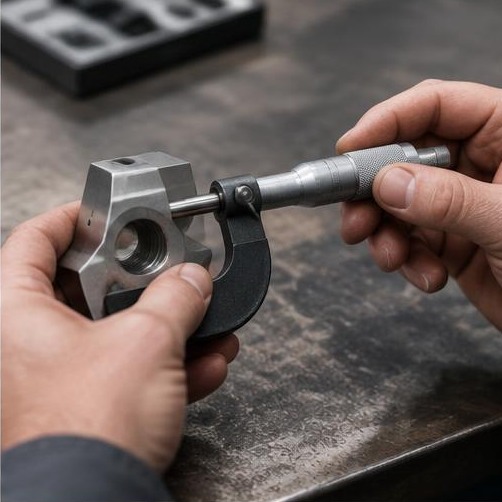
Illustrative machining and inspection imagery. - 03 / 03
IP protection
We sign NDAs before receiving drawings and restrict drawing access to the project team.
What India brings to a machined-parts second source
Trade agreements
India has agreements with the UAE, Australia, Japan, South Korea, the ASEAN states and EFTA, and signed an agreement with the UK in 2025. Preference depends on the agreement being in force and on meeting its rules of origin.
Certificate of origin with every shipment
A certificate of origin travels with the standard document set alongside the commercial invoice, packing list and inspection report, which is what a preferential claim rests on.
ISO 9001:2015 quality systems
A documented quality management system, certified to ISO 9001:2015 and verifiable on the certification body's register. AS9100 and ISO 13485 are not held, so flight-critical and implant work is out of scope.
Familiar drawing standards
ISO 2768 general tolerances, ISO 286 fits, DIN 6885 keyways, DIN 471 grooves and ASME drawings are read and quoted as they are, without redrawing.
NDA before drawings change hands
An NDA is signed on request before any drawing is received, and drawing access is restricted to the project team working on the part.
Established export routes
Shipments leave through Nhava Sheva (JNPT) or Mumbai on EXW, FOB or CIF terms, with sea transit of 18–28 days to Europe and the UK and 25–35 days to the USA.
Qualifying the second source without disrupting supply
Dual sourcing fails when it is attempted on the most difficult part, all at once. Run it on parts you understand, in this order.
- 01
Pick two or three representative parts
Choose parts whose drawings are stable and whose failure modes you already know, not the hardest part you buy. Turned parts, shafts, flanges, fittings and engineering plastics are the natural starting set.
- 02
Sign the NDA, then send the full pack
Drawing with revision, STEP model, grade, both quantities, certificates, Incoterm and destination port. A complete pack is quoted within 24 hours.
- 03
Compare the quotation on landed cost
Add freight, insurance, import charges and your own receiving effort to the piece price. Compare delivered batch cost against your current source, not machining rate against machining rate.
- 04
Run a first article with a dimensional report
Inspect the parts yourself against the same criteria you apply to the incumbent, and fit them in the assembly before going further.
- 05
Place a trial production batch
A real batch at a real quantity exposes packing, documentation and consistency in a way a sample never does. Check the crate, the markings and the paperwork as closely as the parts.
- 06
Dual-release and review annually
Hold both sources approved on the drawing, split volume deliberately and re-quote on the same drawing each year so both prices stay honest.
The supplier in numbers
Facts a procurement team normally asks for before the first call.
- 45+
- Countries exported to
- ISO 9001:2015
- Certified quality management system
- 24 hours
- RFQ response time
- 18–28 days
- Sea transit to Europe and the UK
Shipped from Pune through Nhava Sheva (JNPT) or Mumbai on EXW, FOB or CIF terms.
Verifiable on the certification body's register. AS9100 and ISO 13485 are not held.
On a complete pack: drawing with revision, STEP model, grade and both quantities.
About 4–7 days to the UAE, 25–35 days to the USA, and 2–6 days by air.
The short answer
Why India for China+1 machined components?
India gives machined-parts buyers a second qualified source with comparable delivered cost on many turned and milled parts, ISO 9001:2015 quality systems, English-speaking engineering teams and familiarity with ISO, DIN and ASME drawings. Trade agreements with the UAE, Australia, Japan, South Korea, ASEAN and EFTA, plus the agreement signed with the UK in 2025, can reduce import duty where the agreement is in force and the rules of origin are met. Qualify it on parts you already understand rather than on your hardest component.
- Best-fit scope: turned parts, shafts, flanges, fittings, engineering plastics
- NDA signed before drawings are received; access limited to the project team
- Certificate of origin in the standard document set with every shipment
- First article with a dimensional report before any production release
- ISO 9001:2015 only; no AS9100 or ISO 13485, so no flight-critical or implant work
Keep exploring
Related capabilities, materials and markets
Everything below is machined in the same Pune plant to the same ISO 9001:2015 system. Follow whichever is closest to the part you are sourcing.
Related resources
6- How to Source CNC Machined Parts from India: A Buyer's Guide
- PTFE vs PEEK vs Delrin vs Nylon: Choosing a Machinable Plastic
- Precision Shaft Design Checklist for Pump, Motor and Gearbox Shafts
- Incoterms Explained for Machined Parts Buyers: EXW, FOB and CIF
- 10 Ways to Reduce the Cost of CNC Machined Parts
- Export Packaging for Machined Parts: VCI, ISPM-15 and Crating
Machining capabilities
4Request for quotation
Send your drawing. Get a quote in 24 hours.
Upload STEP, IGES or PDF files. NDA available on request. Quoting: China+1 Sourcing for Precision Machined Components: Why India.