Guide · Buyer essentials
PTFE vs PEEK vs Delrin vs Nylon: Choosing a Machinable Plastic
Compare temperature limits, friction, stiffness, moisture absorption, chemical resistance and cost to choose the right engineering plastic.

ISO 9001:2015 Certified
Documented quality management system
Mitutoyo Quality Inspection
Calipers, micrometers, height gauge, DTIs
Export-Ready Packaging
VCI film, ISPM-15 wooden crates
RFQ Response in 24 Hours
Quote within one working day
NDA Available
Your drawings stay confidential
On this page10 sections
The four polymers side by side
Typical unfilled, extruded or cast stock values. Treat them as selection guidance rather than design data: confirm the figures against the supplier's datasheet for the grade you actually buy.
PTFE
Polytetrafluoroethylene, virgin
- Continuous service
- Up to about +260 °C
- Friction on steel
- Dynamic coefficient about 0.05–0.10, the lowest here
- Moisture uptake
- Below 0.01 %, effectively nil
- Tensile modulus
- About 0.4–0.6 GPa, soft and creep-prone
- Chemical resistance
- Resists almost all industrial chemicals
- Relative cost
- High
- Use it for
- Seals, valve seats, gaskets, chute and tank liners
PEEK
Polyetheretherketone, unfilled
- Continuous service
- About 250 °C; glass transition near 143 °C
- Friction on steel
- Dynamic coefficient about 0.25–0.40 unfilled and dry
- Moisture uptake
- About 0.1–0.5 %
- Tensile modulus
- About 3.6–4.0 GPa, the stiffest here
- Chemical resistance
- Very good; attacked by concentrated sulphuric acid
- Relative cost
- Highest of the four, by a wide margin
- Use it for
- Semiconductor fixtures, hot insulators, pump wear rings
Delrin (acetal)
POM homopolymer and copolymer
- Continuous service
- Up to about 100 °C
- Friction on steel
- Dynamic coefficient about 0.20–0.35
- Moisture uptake
- About 0.2 % at 50 % relative humidity
- Tensile modulus
- About 2.8–3.3 GPa, stiff and dimensionally stable
- Chemical resistance
- Good to fuels and solvents; poor to strong acids
- Relative cost
- Lowest to moderate; usual baseline
- Use it for
- Gears, rollers, spacers, insulators, precision fixtures
Nylon
PA6 and PA66, cast or extruded
- Continuous service
- Up to about 100 °C
- Friction on steel
- Dynamic coefficient about 0.25–0.40
- Moisture uptake
- About 2–3 % at equilibrium, more on immersion
- Tensile modulus
- About 3.0–3.3 GPa dry, markedly lower once conditioned
- Chemical resistance
- Good to oils and alkalis; poor to acids
- Relative cost
- Lowest
- Use it for
- Bushings, wear pads, pulleys, rollers, impact parts
Start here
Quick comparison
PTFE: best chemical resistance and lowest friction, service to +260 °C, but soft and prone to creep.
PEEK: highest strength and temperature resistance (about 250 °C continuous), excellent chemical resistance, and the highest cost.
Delrin (acetal): stiff, dimensionally stable and low friction with very low moisture uptake, good to about 100 °C. Usually the best value for precision parts.
Nylon: tough and wear resistant, low cost, but it absorbs moisture, so dimensions change.
- 01 / 04
When to choose PTFE
Seals, valve seats, gaskets and liners in aggressive chemicals or at extreme temperatures. Consider glass- or carbon-filled PTFE to reduce creep.
- 02 / 04
When to choose PEEK
Semiconductor fixtures, high-temperature insulators, pump wear rings and anywhere a plastic must replace metal under load and heat.
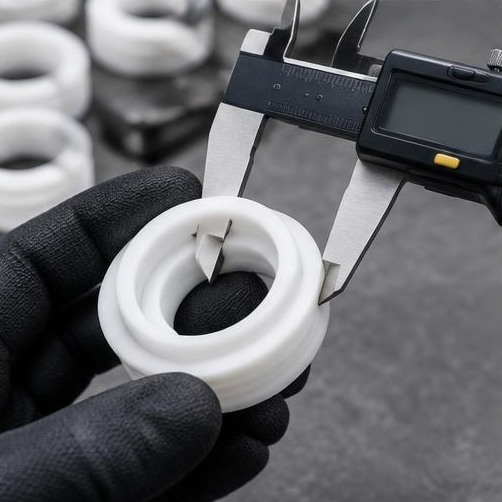
Illustrative machining and inspection imagery. - 03 / 04
When to choose Delrin
Gears, rollers, insulators, spacers and precision fixtures where you need tight tolerances at a moderate price.
Illustrative machining and inspection imagery. - 04 / 04
When to choose Nylon
Bushings, wear pads, pulleys and rollers where toughness and cost matter more than tight tolerances.
PTFE against PEEK, where both survive the temperature
Above roughly 100 °C the choice narrows to these two, and they fail in opposite ways. PTFE gives up strength to gain chemical resistance and slip; PEEK gives up slip and cost to keep load capacity.
| Criterion | PTFE Chemical and friction first | PEEK Load and stiffness first |
|---|---|---|
| Continuous service temperature | Up to about +260 °C | About 250 °C continuous |
| Behaviour under sustained load | Creeps and cold-flows; not suitable for a loaded press fit | Holds dimension under load; can replace metal in many fittings |
| Tensile modulus | About 0.4–0.6 GPa | About 3.6–4.0 GPa, roughly seven times stiffer |
| Friction and dry running | Lowest friction of any common polymer, runs dry | Moderate friction unfilled; bearing grades use PTFE and carbon fillers |
| Chemical attack | Essentially inert to industrial chemicals | Very good, but attacked by concentrated sulphuric acid |
| Machining behaviour | Soft and gummy; sharp tooling, light cuts, easily distorted when clamped | Machines cleanly; benefits from annealed stock and stress relief on tight parts |
| Achievable tolerance | Loose; expect relaxation after machining | Tightest of the four polymers here |
| Relative cost | High | Highest |
Filled PTFE, typically 15–25 % glass or carbon, reduces creep and wear sharply while keeping most of the chemical resistance. It is often the right answer where virgin PTFE deforms and PEEK is unaffordable.
The figures that decide the selection
Four numbers separate these materials more reliably than any datasheet summary.
- +260 °C
- PTFE continuous service limit
- 0.05–0.10
- PTFE dynamic friction on steel
- 2–3 %
- Nylon moisture uptake at equilibrium
- ~4 GPa
- PEEK tensile modulus
PEEK is close behind at roughly 250 °C; acetal and nylon stop near 100 °C.
Three to six times lower than PEEK, acetal or nylon unfilled.
Against about 0.2 % for acetal and under 0.01 % for PTFE, which is why nylon moves.
Roughly seven times PTFE, and the reason PEEK replaces metal under load.
Specifying a machined plastic part
Polymer parts are quoted from the same drawings as metal parts, but they do not behave like metal. These are the entries that make a plastic drawing buildable.
State these on the drawing
- The polymer and the grade, not just the family: PTFE virgin or 25 % glass filled, POM-H or POM-C, PA6 cast or PA66 extruded
- Operating temperature range, and the media or chemicals the part will see
- Which two or three dimensions are functional; general tolerances to ISO 2768-m elsewhere
- Stock form where it matters, since rod, tube and plate relax differently after machining
- Whether a stress-relief or annealing step is required between roughing and finishing
- For nylon, the humidity at which the dimensions apply, and any clearance allowed for swelling
- Surface finish only where it has a function, such as a sealing face or a bearing bore
Avoid these specifications
- PTFE in a loaded press fit or a threaded joint carrying torque; it will cold-flow
- Nylon on an ISO 286 fit in humid or wet service, where moisture growth moves the dimension off tolerance
- Metal-grade fits such as h6 on long plastic diameters, with no relaxation allowance
- PEEK chosen for chemical resistance alone, where filled PTFE or acetal would do the same job far cheaper
- Acetal or nylon above roughly 100 °C continuous, or acetal in strong acids
- Thin unsupported webs and deep narrow pockets, which spring away from the cutter
- Requesting a certified hardness or material test in house; material testing is not done on site
The short answer
Which machinable plastic should you choose?
Start with acetal (Delrin) and only move away from it for a reason. Acetal is stiff, dimensionally stable, low friction and the cheapest to hold a tolerance in. Switch to PTFE when chemical attack or friction governs and the part carries almost no load; to PEEK when the part must hold strength above roughly 150 °C or replace a metal component; and to nylon only where toughness and price matter more than dimensional accuracy.
- Acetal: gears, rollers, spacers, precision fixtures to about 100 °C
- PTFE: seals, valve seats, gaskets, liners; use filled grades to curb creep
- PEEK: hot insulators, wear rings, semiconductor fixtures; highest cost
- Nylon: bushings, wear pads and pulleys; allow for 2–3 % moisture uptake
- Machined in Pune on CNC turning centres and a 3-axis VMC from your drawing and STEP model
Keep exploring
Related capabilities, materials and markets
Everything below is machined in the same Pune plant to the same ISO 9001:2015 system. Follow whichever is closest to the part you are sourcing.
Related resources
6- How to Source CNC Machined Parts from India: A Buyer's Guide
- Precision Shaft Design Checklist for Pump, Motor and Gearbox Shafts
- Incoterms Explained for Machined Parts Buyers: EXW, FOB and CIF
- 10 Ways to Reduce the Cost of CNC Machined Parts
- Export Packaging for Machined Parts: VCI, ISPM-15 and Crating
- China+1 Sourcing for Precision Machined Components: Why India
Machining capabilities
4Request for quotation
Send your drawing. Get a quote in 24 hours.
Upload STEP, IGES or PDF files. NDA available on request. Quoting: PTFE vs PEEK vs Delrin vs Nylon: Choosing a Machinable Plastic.